A breakthrough in compostable biodegradable hot melt for packaging and paper
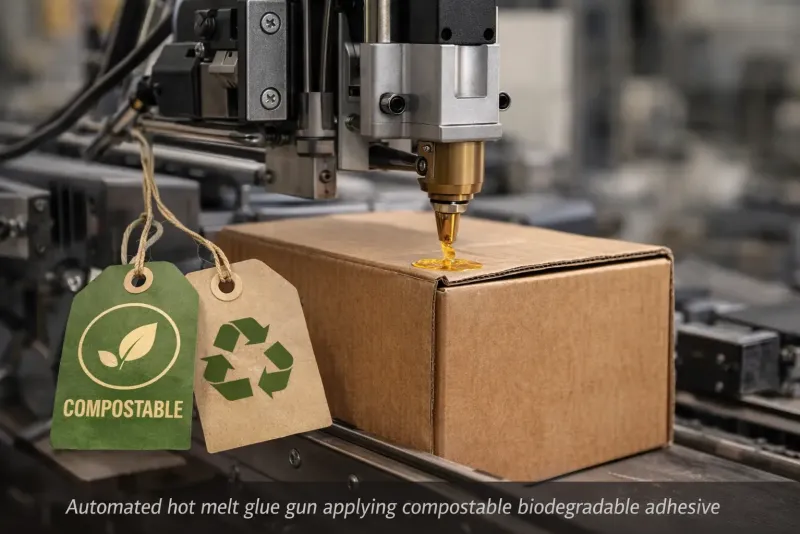
For years, the hot melt industry has been moving toward more sustainable solutions. But one question has remained difficult: how do you improve the environmental profile of an adhesive without giving up the speed, processability and reliability that make hot melt systems so widely used?
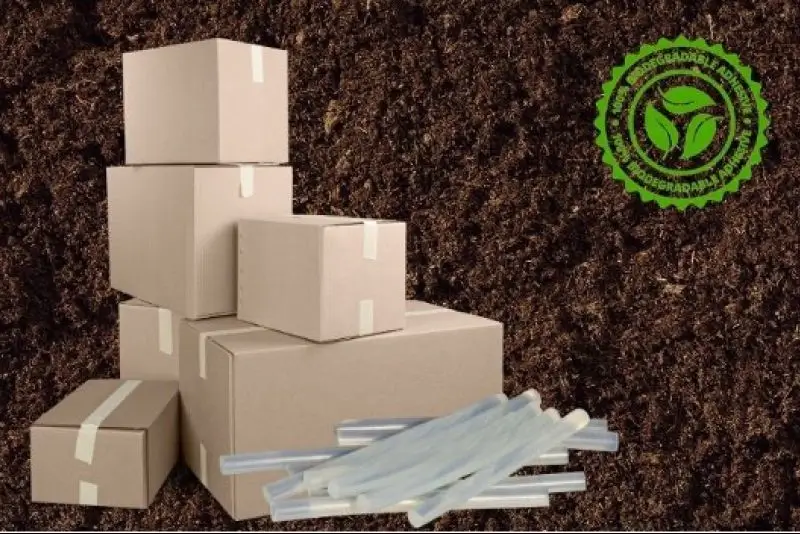
In early 2025, an important breakthrough created new possibilities for 100% compostable biodegradable hot melt adhesive, especially for packaging and paper applications.
That makes this development highly relevant for manufacturers working on more sustainable packaging concepts. Because in the end, sustainability only creates value when it can be translated into something practical, stable and realistic in production.
At Adhesives & Coatings, we help customers move from opportunity to implementation. From the quotation stage onward, we support projects with experienced technical staff, our own laboratory and tailor-made fine-tuning as a standard service.
Why this breakthrough matters
In many packaging projects, the adhesive is not the first thing people talk about. Most of the attention goes to the visible materials: paper, board, films or coatings. Yet the adhesive can still play a decisive role in the sustainability profile of the final structure.
That is why this breakthrough matters. It shows that more sustainable adhesive development is not only theoretical. It creates new possibilities for packaging and paper applications where compostability, performance and feasibility need to be considered together.
For companies exploring more sustainable packaging, this changes the conversation. The adhesive is no longer only a supporting detail. It becomes part of the wider design strategy.
Built on many years of hot melt experience
At Adhesives & Coatings, we have worked in the hot melt industry for many years. That experience matters because adhesive projects are rarely solved by a single claim or one technical property.
In real applications, success depends on the total picture:
- the substrates involved;
- the packaging format;
- line speed;
- machine setup;
- required bond characteristics;
- end-use conditions;
- sustainability goals.
A breakthrough only becomes useful when it can be translated into something that works in practice. That is why technical support and application knowledge remain essential.
100% compostable biodegradable hot melt for packaging and paper
The breakthrough reached in early 2025 is especially relevant for packaging and paper. In these sectors, the adhesive can strongly influence whether the final structure truly supports a more sustainable packaging concept.
A 100% compostable biodegradable hot melt creates fresh opportunities for manufacturers that want to rethink packaging while still relying on the practical strengths of hot melt processing. It offers a more promising route for applications where environmental ambition and industrial usability must move together.
This makes the development highly relevant for packaging designers, converters and manufacturers looking for solutions that are not only more sustainable in principle, but also aligned with recognized standards and assessment frameworks such as EN 13432, ASTM D6400, ASTM D6954 and CHIRA recyclability assessment. CHIRA is the CHI Recyclability Assessment developed by cyclos-HTP for evaluating and optimizing the recyclability of packaging.
Aligned with EN 13432, ASTM D6400, ASTM D6954 and CHIRA recyclability assessment
For packaging projects where compostability, biodegradability and recyclability all matter, standards and assessment frameworks play a major role.
European Norm EN 13432 is an important reference when assessing whether materials are suitable for industrial composting. ASTM D6400 is widely used in relation to compostable materials, while ASTM D6954 is relevant when looking at degradation behaviour under environmental conditions. In addition, CHIRA — the CHI Recyclability Assessment — is used to evaluate the recyclability of packaging and support packaging optimization for recycling.
For compostable biodegradable hot melt adhesive, this matters because the adhesive should support the sustainability ambition of the total packaging structure. If a package is being developed with compostability or improved recyclability in mind, the adhesive cannot be treated as a secondary detail.
By taking EN 13432, ASTM D6400, ASTM D6954 and CHIRA into account early in the project, manufacturers can make better-informed decisions about adhesive selection, technical feasibility and the overall sustainability direction of the packaging design.
From quotation to implementation
A breakthrough on its own is not yet a packaging solution. The real work begins when a manufacturer asks how that development fits a real product, a real process and a real commercial objective.
That is why we support prospects and customers throughout the full trajectory, starting from the quotation stage. We discuss the application, the technical requirements, the sustainability objectives and the production conditions. From there, we help identify the most suitable direction, support testing and evaluation, and assist in moving toward implementation.
This approach helps turn innovation into something practical, realistic and commercially usable.
Own laboratory and tailor-made fine-tuning as standard
No two packaging projects are exactly alike. Some require a different bond profile. Others are influenced by substrate choice, speed, temperature window or handling requirements. That is why tailor-made fine-tuning is part of our standard service.
With our own laboratory, we can support customers more effectively in evaluating adhesive behaviour and moving toward the most suitable solution for the application. This allows us to combine technical adhesive knowledge with practical process understanding.
For manufacturers, that means the project does not stop at a promising concept. It can be developed further into something more specific, more practical and more relevant to the actual production environment.
Performance and sustainability should move together
A sustainable adhesive solution only matters when it also performs where it counts: on the line, in the pack and in the intended application.
That is why the key question is never only whether an adhesive is biodegradable or compostable. The more important question is whether it can support the packaging concept in a technically workable and commercially sensible way.
This is exactly what makes the recent breakthrough so promising. It supports the idea that sustainability and performance do not have to be opposing forces.
New opportunities for sustainable packaging development
As packaging requirements continue to evolve, manufacturers are looking for solutions that are not only more sustainable, but also realistic to implement.
Compostable biodegradable hot melt can create new opportunities for:
- compostable packaging projects;
- more sustainable packaging innovation;
- lower-impact bonded structures;
- customer-specific development trajectories;
- packaging concepts that require technical guidance from the earliest stage.
For companies active in packaging and paper, this is the right time to explore what these possibilities may mean in practice.
Interested in compostable biodegradable hot melt for packaging and paper?
We are happy to help you explore the possibilities, assess the technical requirements and identify the most suitable next steps for your application. Feel free to contact us to discuss testing, implementation and tailor-made fine-tuning.
What solution are you looking for?
We are specialized in the packaging and paper. Need the best products or advice? Then please leave your details and we will get in touch.